The most important aspect of this festival is the Mango Exhibition where one can find a variety of Mangoes from all over India. As the name suggests, this festival is an ode to the king of fruits- Mango! The traditional Punjabi festival of Baisakhi is celebrated in April every year.
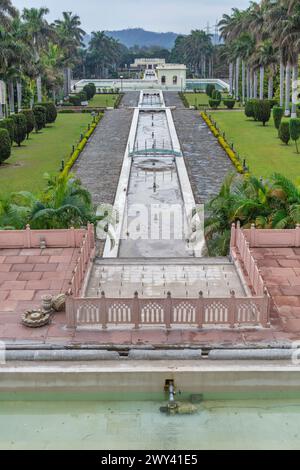
Since the time of Shah Jahan, mughals reserved the pavilions with Balustered columns supporting the cusped arches only for the use of emperor and his immediate family, hence, it was likely built for Aurangzeb's personal use as summer retreat. It was built in the foothills of Himalayas as one of the Mughal gardens summer retreat for the Aurangzeb (r. 1658–1707), who then had his capital at Lahore, by his foster brother and architect Muzaffar Hussain. It is an example of the Mughal gardens architectural style, which was renovated by the Patiala dynasty Sikh rulers. The rest of the garden is laid out with ponds, flowers, trees, and fountains. Today, Pinjore Garden stands as a testament to Mughal and Rajput architectural styles and continues to attract visitors with its serene ambiance and lush greenery. During the visit to the Pinjore garden, one may also taste the local Haryanvi food.
Pinjore garden is a fine example of terrace-gardening in India and serves as the venue of the annual Mango festival during Baisakhi. The garden is beautifully illuminated, and various cultural programs are organized, making it a vibrant and festive experience for visitors. The central water channel runs through the length of the garden, with fountains placed at regular intervals, creating a mesmerizing display. This terrace is adorned with Mughal-style pavilions and lush lawns, providing a grand introduction to the garden’s splendor. While Pinjore Garden is beautiful year-round, the best time to visit is during the spring and autumn months when the weather is pleasant, and the garden is in full bloom.
This terrace is also known Yadavindra Gardens as the Top Terrace, as it offers a bird’s eye view of the entire garden and the town of Pinjore. The terrace also has a Japanese garden, with a pond, a bridge, a pagoda, and a Buddha statue. The terrace also has a cactus garden, with over 2500 species of cacti and succulents.
Additional charges may apply for special events or exhibitions held within the garden premises. Pinjore Garden is open to visitors throughout the year, offering a unique experience in every season. After India gained independence in 1947, the garden came under the jurisdiction of the Haryana government. The British colonial period also saw efforts to maintain and restore the garden, further cementing its status as a heritage site. However, it was later revived by the rulers of the Patiala State, who recognized its historical and cultural significance.
It is an instance of the Mughal Gardens style, and changed into constructed via way of means of Patiala Dynasty Rulers.The lawn is withinside the village of Pinjore lie 22 km from Chandigarh at the Ambala-Shimla avenue. Pinjore Gardens (additionally called Pinjor Gardens or Yadavindra Gardens) is placed in Pinjore This is further decorated with wide variety of colourful flowers that makes the garden a place of fantasy. He planned both sides of the waterway to be planted with the patches of green bordered with flowers, along with cover the entire place with a number of trees, like traditional palm, cypress and magnolia. History of Yadavindra GardensEarly in the 17th century, Nawab Fidai Khan, a reputed architect and the cousin of Mughal Emperor Aurangzeb, made the design for the Yadavindra Gardens.
The garden remains open for all days of the week from 7 am to 10 pm. The place is popular not just for the garden but also for the annual Mango Mela. Designed with the amalgamation of Persian, Turkish, and Indian architecture, the garden is spread over 100 acres. The garden is situated in the Pinjore city of Panchkula, in the territory of Haryana. One of the historical Mughal Gardens, Pinjore Garden was built in the 17th century by a renowned Mughal ruler Aurangzeb. Her book is regarded as the first serious study of Indian garden design.
In recent times, it has been renamed as Yadavindra Garden in his memory. The Maharaja Yadavindra Singh ( ) of the princely state of Patiala restored the garden to its former splendour. It is an examples of the Mughal Gardens architectural style, which was renovated by the Patiala Dynasty Sikh Rulers. Pinjore Gardens is a place that offers a complete package of entertainment, education, and enjoyment for all kinds of visitors. These festivals showcase the local traditions, arts, crafts, music, dance, and food of Haryana.
Nasze marki:



Siedziba firmy: EKO Będzin, ul. Adama Mickiewicza 101
ŚPAK – Śląska Pracownia Artystyczno Kulturalna , Bytom, ul. Krawiecka 2
Salon Mebli Dąbrowa Górnicza, DH HETMAN, ul. Jana III Sobieskiego 4a
Meble EKO CH M1 Czeladź, Będzińska 80
 (+48) 502 620 014
  biuro@antykmeble.pl, spak.bytom@gmail.com

 (+48) 502 620 014
  (+48) 506 911 900

